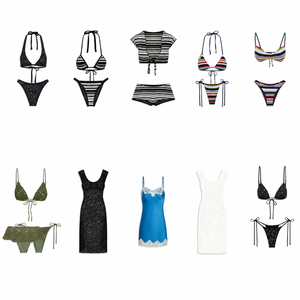
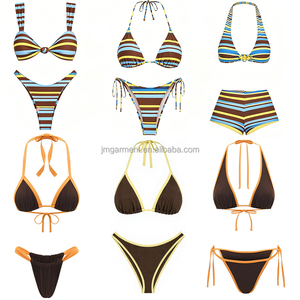
Our internal technical design atelier leverages industrial 2D CAD digitizers to grade each bikini silhouette across global standard metrics. Precision anatomical grading guarantees consistent fit contours without dimensional distortion across size curves.
Elimination of loose waistbands & shoulder drag
Direct vector marker conversion for minimal cut loss
Custom fit curves for US, UK, EU, and AU demographics
Solar-Powered Fabrication
Operating under dedicated photovoltaic microgrids generating 92 MWh clean energy annually, our Bali facility drastically reduces cradle-to-gate carbon footprints, empowering partner brands with auditable ESG reporting credentials.
Zero grid peak emissions during sewing cycles
Closed-loop textile cutting with zero-landfill target
BPJS healthcare coverage and above-living wages
OEKO-TEX Certified Printing Lab
State-of-the-art wide-format dispersion printers utilize aqueous, eco-certified dispersant colorants. In-house strike-offs are approved before roll cutting to guarantee 100% color match, zero color migration, and chemical safety.
ISO 105-E03 Grade 4-5 chlorine fastness
Zero toxic azo dyestuffs or alkylphenol ethoxylates
Vibrant neon, metallic, and photographic print fidelity
CE Certification Reality for Sexy Bikini Manufacturers: Compliance Architecture
In global textile and apparel trade, the search intent surrounding "CE Certified Sexy Bikini Manufacturers" addresses the stringent chemical, mechanical, and safety conformity standards mandated for entering European and Tier-1 worldwide consumer markets. While general textile swimsuits do not fall under traditional CE Machinery Directives, specialized resort swimwear, UPF-rated protective swim apparel, and metal-embellished luxury bikinis are regulated under the European Union General Product Safety Regulation (GPSR EU 2023/988), Personal Protective Equipment Regulation (EU 2016/425 for UPF50+ sun protection), and REACH Regulation (EC No 1907/2006) Annex XVII.
Balidao Swimwear Co., Ltd. implements complete traceability across every critical component of luxury bikini construction. Sourcing sexy swimwear without auditable compliance documentation introduces devastating risks of customs impoundment, European RAPEX recall notices, and catastrophic brand reputational degradation. Below is our manufacturing compliance standard enforced across all private label swimwear lines:
Compliance Vector
Regulatory Reference
Safety Parameter & Benchmark
Production Verification Protocol
Heavy Metal & Nickel Migration
REACH Annex XVII (Entry 27) / EN 1811
Nickel release < 0.5 µg/cm²/week for direct prolonged dermal contact hardware
Vacuum PVD coating with electrophoretic lacquer dipping; saline immersion testing
Carcinogenic Arylamines
REACH Annex XVII (Entry 43) / EN ISO 14362-1
Non-detectable (< 30 mg/kg) cleavage of 24 prohibited aromatic amines
OEKO-TEX Standard 100 Class I certified water-based ink dispersion systems
Phthalate Plasticizers
REACH Annex XVII (Entry 51 & 52)
Total DEHP, DBP, BBP, DINP, DIDP, DNOP < 0.1% by weight in hygienic liners
Biodegradable non-toxic cornstarch and medical-grade EVA barrier adhesives
UV Sun Protection (PPE)
EN 13758-2 / UV Standard 801
UPF Rating 50+ retaining blocking efficacy after 50 wash/immersion cycles
High-density microfilament knitting with Carvico VITA regenerated yarn matrix
Seam Tensile & Recovery
ASTM D4964 / ISO 13934-2
Seam elasticity elongation > 120% without stitch break or fiber slippage
Industrial 4-thread overlock (ISO 504) and twin-needle coverstitch (ISO 406)
By enforcing this comprehensive quality assurance matrix, our manufacturing facility provides downstream retail and direct-to-consumer labels with frictionless entry into EU, UKCA, and FDA-regulated jurisdictions. From rust-free zamak alloy rings to hypoallergenic siliconized underbust grips, our material selection protects both consumer dermatological health and brand longevity.
Technical Analysis of Featured High-End Bikini Archetypes
Creating seductive, high-demand swim silhouettes requires balancing aesthetic minimalism with anatomical physics. When raw fabric surface area is minimized, structural tension across seams and elastic tensioning must be calibrated to prevent slippage, rolling, and seam fatigue. Here is the technical breakdown of our signature swimwear configurations:
1. Architectural Push-Up & Metallic Hardware Bikini Systems
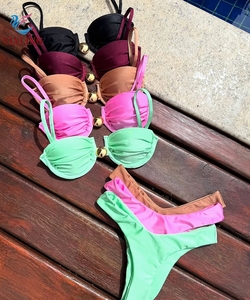
Featured in our Push-Up Gold Starfish collection, this silhouette integrates hydro-repellent PU internal molded cups engineered to maintain structural lift without waterlogging. Traditional metal trim frequently corrodes when exposed to chlorinated pool chemicals or hypersaline seawater. We specify marine-grade Zamak-3 zinc die-cast hardware electroplated in 24k gold tone, protected by an oven-cured electrophoretic clear coat. These components withstand over 96 hours of ASTM B117 neutral salt spray testing without pitting or surface dulling.
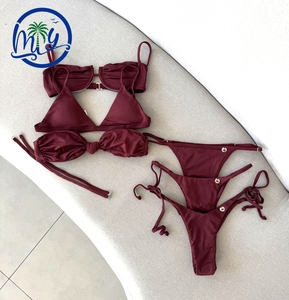
Micro-cut sexy bikinis demand razor-sharp grading. Utilizing high-recovery Italian Carvico VITA (78% Recycled Polyamide, 22% Elastane at 190 g/m²), our micro-thong patterns feature zero-edge zig-zag interior silicone thread reinforcement. This prevents the bottom from shifting or cutting uncomfortably into soft tissue. Elastic tension is distributed along anatomical gluteal curvature rather than relying on abrasive lateral binding, providing unparalleled stability during movement.
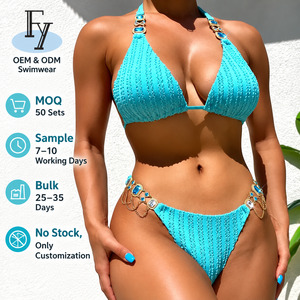
Textured rib fabrics and jacquard crinkle textiles provide tactile luxury and sculpted smoothing. Integrating jeweled chains requires specialized engineering: every hardware load point is internally backed with laser-cut hypalon interlinings to distribute shear forces evenly across the fabric weave. This safeguards against blowout tears during rigorous surf or beach lounging, meeting the stringent retail durability demands of luxury department stores.
Future Sourcing & Procurement Trends: The 2025–2030 Swimwear Horizon
Procurement teams and swimwear startup founders must anticipate major regulatory, chemical, and consumer behavioral shifts reshaping the global swimwear supply chain:
Strategic Market Intelligence: By 2026, the European Union's Ecodesign for Sustainable Products Regulation (ESPR) will mandate Digital Product Passports (DPP) for all apparel items entering the single market. Manufacturers lacking automated material origin traceability, chemical audit logs, and environmental lifecycle datasets will face insurmountable regulatory market access barriers.
1. The Transition to Circular, Chemically-Regenerated Polyamides
Mechanical recycling of PET plastics (such as standard rPET water bottles) is rapidly falling out of favor among high-end swimwear labels due to microplastic shedding and polymer degradation after repeated wash-and-wear cycles. Modern procurement contracts prioritize closed-loop chemical regeneration, spearheaded by Aquafil's ECONYL®. This process recovers post-consumer nylon waste (discarded fishing nets, carpet fluff, and industrial scraps) and reconstitutes it back to virgin-purity caprolactam. When combined with chlorine-resistant LYCRA® Xtra Life™, the resulting fabric demonstrates 10x greater resistance to fiber thinning and bagging compared to generic elastane swimwear.
2. Digital Product Passports & Hyper-Transparent Traceability
Wholesale buyers are shifting from self-declared ethical claims to QR-encoded immutable blockchain documentation. Our Bali manufacturing infrastructure provides complete chain-of-custody data packets, detailing raw fiber origin, weaving mill certifications, non-toxic ink batch testing, and solar energy displacement figures per unit manufactured. This enables partner labels to print scannable care labels that build instant trust with conscientious Gen-Z and Millennial consumers.
Sun creams, tanning oils, and body lotions are notorious for destabilizing synthetic polyurethane fibers, causing permanent yellowing and elasticity failure. Next-generation fabric development includes micro-encapsulated oleophobic barriers woven into the yarn lattice. These prevent lipid penetration without impairing fabric breathability or hand feel, dramatically extending product lifespans and reducing customer return rates for online DTC brands.
Competitive Advantages: Why Global Labels Scale With Balidao Swimwear Co., Ltd.
Since 2014, Balidao Swimwear Co., Ltd. has disrupted outdated apparel manufacturing paradigms by bridging the gap between inaccessible corporate factories (demanding 1,000+ piece minimums per color) and unreliable cottage workshops. Operating our flagship solar-powered production center in Denpasar, Bali, we deliver high-tier industrial precision backed by human craftsmanship:
Hyper-Agile Minimum Order Quantities (MOQ): We champion emerging swimwear visionaries. Our production framework begins at just 100 units for Ready Design (white label) configurations and 250 units for fully bespoke private label styles. Crucially, we enforce zero minimum order requirements per size, allowing you to calibrate sizing distributions precisely to your brand's regional demographic.
Rapid Prototype Development: In-house 2D CAD digitizing and dedicated sample cutting lines allow us to dispatch fit-tested Ready Design samples in as few as 3 business days, and bespoke development prototypes within 2 weeks. Every fit revision is executed by the identical pattern team responsible for subsequent bulk production, eliminating fit drift across production batches.
Comprehensive Brand Incubation Ecosystem: Beyond textile cutting and sewing, our campus houses dedicated multi-media studios for campaign photography, lookbook video production, branded eco-packaging solutions (including zero-plastic tapioca resin bags and recycled hangtags), and direct-to-door worldwide DHL Express fulfillment across 70+ nations within 4 to 5 transit days.
Procurement Knowledge Base
Frequently Asked Sourcing & Compliance Questions
Clear technical insights from our senior production engineers to help you navigate custom bikini manufacturing with total confidence.
What does CE compliance mean for private label bikini manufacturing?
While standard two-piece bikinis do not require a CE badge like industrial machinery, CE compliance in this vertical refers to strict adherence to EU Directives. This encompasses REACH chemical safety (non-detectable forbidden amines, phthalates, and formaldehyde), nickel release limits on metallic hardware under EN 1811, and Personal Protective Equipment (PPE) standards if the swimwear is advertised with specific UPF 50+ ultraviolet protection claims.
How do you guarantee that metallic bikini hardware will not rust or irritate skin?
We exclusively utilize marine-grade zinc-alloy (Zamak-3) or 316L medical stainless steel for our custom chains, rings, starfish charms, and sliders. All hardware undergoes physical vapor deposition (PVD) gold/silver plating followed by a baked electrophoretic transparent lacquer seal. Our hardware lots pass 96-hour continuous salt water immersion tests and comply strictly with EU REACH nickel release thresholds.
Can I launch a collection without professional fashion design tech packs?
Yes. Our internal engineering department regularly initiates development from mood boards, hand sketches, inspirational photographs, or physical benchmark garments. Our technical CAD pattern cutters draft the master digital vector blueprints, engineer construction specifications, advise on ideal elastane tensions, and guide you through the grading process seamlessly.
What is the difference between your Ready Design and Bespoke Private Label routes?
Ready Design (White Label) leverages our library of hundreds of pre-graded, fit-tested silhouettes that are cut and sewn in your choice of stocked fabrics, custom prints, and custom heat-transfer branding, starting at 100 units. Bespoke Private Label develops unique, exclusive patterns from scratch based on your custom tech specifications, starting at 250 units. Both can be combined in one collection.
How do you handle colorfastness against chlorine, salt water, and UV rays?
We formulate our in-house wide-format sublimation and dispersion printing processes exclusively with OEKO-TEX Standard 100 certified eco-inks. Fabrics undergo standardized testing according to ISO 105-E02 (color fastness to sea water) and ISO 105-E03 (color fastness to chlorinated swimming pool water), maintaining an outstanding Grade 4-5 performance rating against color bleed, fading, or wet rub-off.
What are your lead times from initial sample sign-off to bulk dispatch?
Sample creation requires approximately 3 business days for Ready Design blocks and 2 weeks for custom 2D CAD private label prototypes. Once the physical sample is signed off and purchase order confirmed, bulk production spans 4 to 8 weeks depending on style complexity and volume. Express international shipping via our DHL priority logistics hub delivers finished orders within 4 to 5 business days worldwide.
Build Your Compliant Luxury Swimwear Line
Collaborate directly with Bali's premier solar-powered swimwear factory. Low minimums, certified ethical standards, and uncompromising European quality control.